



Ambling through the courtyard of Somerset House on a warm summer’s evening makes you feel like you’ve wandered onto a Merchant & Ivory production without your costume. It’s a magical place, but it also makes you feel sort of unworthy of it.
Finding the entrance to the Maurits Cornelis Escher exhibition is not dissimilar to the sensation of viewing one of his pieces. Tumbling staircases lead you to false floors, and entrances become exits depending on the angle you approach them.
So yeah, we were lost.
Escher has always been a fascination to artists of myriad disciplines. For graphic designers, he is a key figure of the creative vanguard, taking his place alongside Salvador Dali and Andy Warhol.
You see Escher’s playfulness in much of contemporary design: repeating patterns, false perspectives, collapsing structures and the merger of two- and three-dimensional elements.
You see him in architecture: Studio 10’s “Dream” and “Maze” Rooms, located in Guilin, China, where interiors feature illusory hotel rooms with “impossible” staircases and twisting walls and ceilings.
You see him in our movies too. Observe Christopher Nolan’s implausible buildings in Inception, or his depiction of tessellation (more on that later) in Interstellar, where the boundaries between art and mathematics are dissolved.
You even find him in comedy. Deadpan 90s comedian Steve Wright (of Reservoir Dogs’ ‘super-sounds of the seventies’ fame) famously built his act around comic non-sequiturs that would loop around themselves and end up at the beginning again: “Went to the store and bought a pack of batteries. They weren’t included so I had to buy them again.”
Once we find our bearings, we shuffle into the first room. An audible gasp could be heard from us, as our eyes fell on the bounty of intricate woodcut pieces.
One such piece, Day & Night (1938), depicts two cities separated by an ocean made of interlocking birds, some black, some white, and deployed with the clever use of negative space. The detail is, of course, unfathomable.
As with much of Escher’s work, you can study how a piece was achieved, but your brain can never quite process what it’s seeing. A paradox of sensations.
I discovered M.C Escher as a teenager, albeit accidentally, through the music of Pink Floyd. The cover of their 1969 double album, Ummagumma, features a photograph of the band sitting beyond a doorway, leading into a lush garden. There’s a picture hanging on the wall by the door depicting the very photograph we’re already seeing. Under closer inspection, the picture on the wall continuously duplicates the entire scene, over and over again like a hall of mirrors.
Moving into the next room, we learn about Escher’s passion for travel. Leaving his Dutch homestead for the charming countryside of Italy and Spain, he was enthralled by the Moorish tile art (tessellation) that had spread from North Africa in the Middle Ages to Florence, Siena and Ravello, and to Madrid, Toledo and Granada. It was in Granada, Spain, where Escher witnessed the Moorish architecture of the Alhambra palace, a 14th-century structure housing beautiful tessellations (repetitive, interlocking patterns of coloured tiles) sculpted on the walls and ceilings.
The sketches he brought back would form the backbone of some of his most seminal work, most of which were here, just inches from our noses. “Sky and Water” (1938), for example, sports repeating birds that seamlessly morph into fish.
We slinked across the chequerboard floor and weaved through a succession of giant reflective spheres (a nod to his lithograph, “Hand with reflecting sphere”) and found our first interactive experience: a room comprised of reflecting mirrored surfaces with white birds suspended from lengths of wire.
Naturally, we got our phones out.
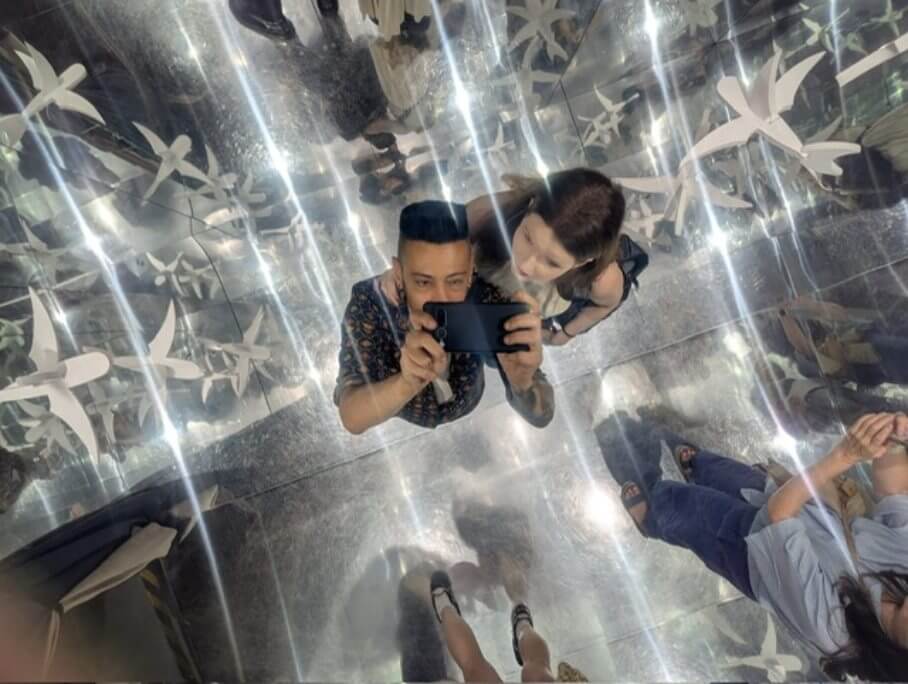
The walls, ceiling and floor seemed to melt into infinity as each reflective surface duplicated itself in the other. Known as the Droste effect (where a picture recursively appears within itself), the sensation was one of being suspended in mid-air. Hard surfaces and clear, defined edges were absent, meaning you could only perceive the room as vast and liquid.
Far out, man.
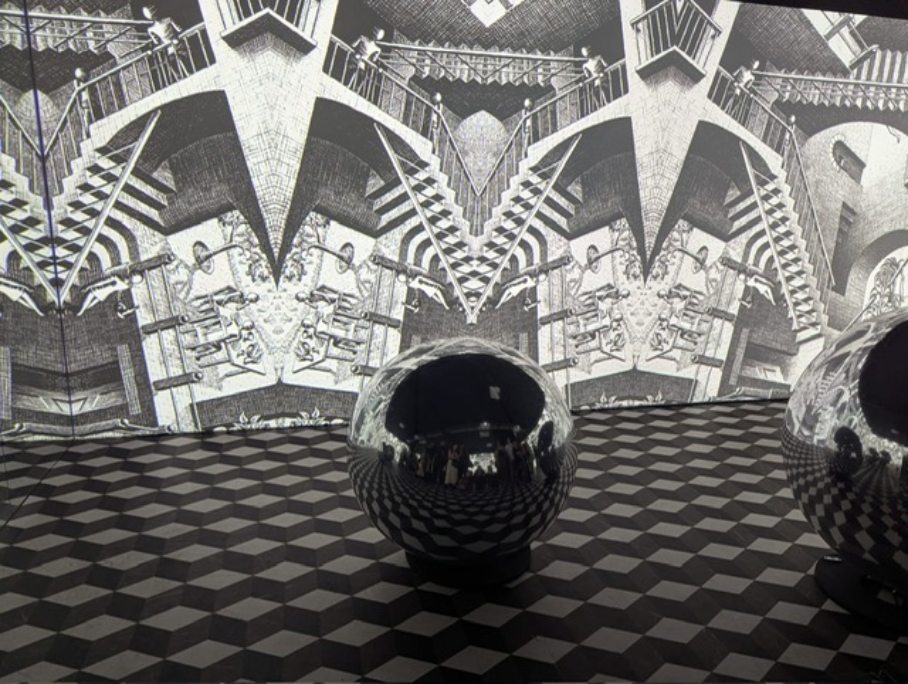
There were plenty more selfie-stick shenanigans to be had. A false perspective room where you stand in the corner appearing further away than you actually are, a kaleidoscope projector that would bend tessellation patterns across your face when you stood in front of it, and a “secret cinema” space where you enter a room with projections of Escher’s work beamed across the wall and reflecting off the surfaces of more giant spheres. The floor pattern gave off strong Twin Peaks vibes, which was no bad thing at all.
As the experience drew to a close, we tried to gauge how long we were there for. An hour. Two hours? Time, it seemed, had melted to an abstraction.
Anyway, we retraced our steps to find our way out but found ourselves in the queue to re-enter the exhibition again. We were tempted, but decided, instead, to slip out through the back. Or was it the front?